Manufacturing Engineering Modular Series: Manufacturing Information and Data Systems
The aim of data modelling is to describe a system model that can then be used to create a database containing the same information as the original system. Data modelling theory is as new as the relational model. A data model is defined as a collection of mathematically well-defined concepts that help one to consider and express the static and dynamic properties of data-intensive applications (Brodie, 1984). Therefore, a general form for representing a system model would be in terms of entities and their attributes, relationships between entities, and the dependencies of these relationships.
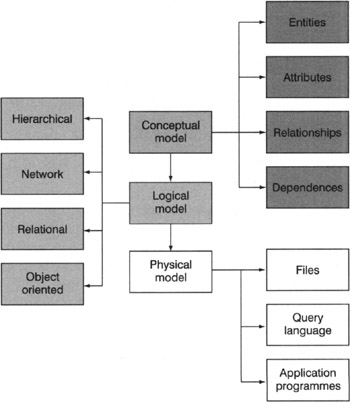
Data models are essential for the development of information systems, and provide a conceptual basis for analysis. They capture the dynamic and static properties required to support the desired process. Conceptual modelling is the process of modelling all properties of an application, and is required to allow the development of application-specific data models. In addition to the static and dynamic aspects, it is also necessary to specify integrity constraints to define allowable states of the database and legal operations. This then allows us to move on to the logical and physical models, as shown in Figure 2.9.
Data modelling produces a schema, defining objects, attributes and relationships, and definitions of transactions. Once these are defined, various attributes can be selected to be presented differently according to the application they are needed for. Figure 2.10 shows the definition of two schemata...