Mobile and Wireless Communications: Key Technologies and Future Applications

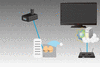
The success of IEEE802.11b wireless LAN technology is undoubtedly due to the ease of use of the technology, the acceptance of standards, the low cost of the equipment, and the real need for such services. Client-side equipment is widely available in the credit card size PCMCIA (Personal Computer Memory Card International Association) card format suitable for laptops and PDAs, for less than 100. ISA (Industry Standard Architecture) and PCI (Peripheral Component Interconnect) cards are also available from some manufacturers for desktop machines. Access points, costing 100 1000 depending on functionality, typically occupy a footprint no bigger than an A5 sheet of paper and can be wall or ceiling mounted, or may be hidden behind ceiling panels or in cable risers within an office.
While initial adoption of wireless LAN systems has traditionally been in vertical markets such as retail, warehousing and manufacturing, current growth is being driven by other market segments. These include enterprise, small office/home office, telecommunications/Internet service provider (ISP) and the public access environment. Wireless peripheral connectivity, wireless Internet and higher throughput compared to cellular mobile networks are the lead drivers for wireless LAN deployment. Voice over IP (VoIP) is also expected to drive this technology in the future.
The introduction of seamless roaming is also believed [5] to be an important next step development for wireless LAN networks and one that BT is in a strong position to implement.
Cells of wireless LAN coverage at public hot-spots such...