Modelling of Mechanical Systems: Structural Elements, Volume 2
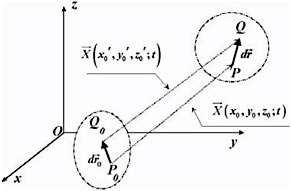
When loaded, the solid body is deformed, but, in most cases of practical interest, very slightly in comparison with the deformations experienced by fluids. So, in a solid, material points which are initially very close together remain close together during deformation and the Lagrangian description is well adapted to formulate the equations of mechanical equilibrium. The motion is described by a displacement vector field which is referenced to the initial (non-deformed) configuration (Figure 1.1). If the body is deformed during motion, the distance between two material points is changed. So, the deformation rate has to be related in some suitable manner to the relative change of length of an infinitesimal segment, giving rise to the concept of strain tensor, denoted in symbolic notation
. The tensor nature of
arises as a consequence of the fact that the change of length generally depends upon the direction, but not upon the coordinate system. See Appendix A.1 for a brief presentation of vector and tensor calculus.
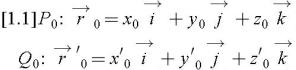
Let P 0 and Q 0 be two infinitely neighbouring material points of the initial configuration (time t = 0). Their position is defined in a Cartesian coordinate system of unit vectors
,
,
as:
At a later time t, P 0 and Q 0 are mapped into the slightly displaced points P