Motion Vision: Design of Compact Motion Sensing Solutions for Autonomous Systems Navigation

Vehicle navigation in dynamic environments is an important challenge, especially when the motion of the objects populating the environment is unknown.
Large et al. [186 ]
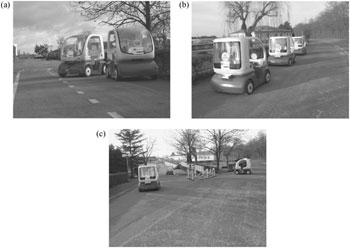
For some time we have been dealing with the design and development of cooperative autonomous vehicles. That is, we build vehicles that are not only intelligent in themselves (e.g. able to follow a lane or to avoid a collision with road obstacles such as other vehicles, bikes, pedestrians, etc.), but that can also explicitly cooperate with other autonomous vehicles so that both the individual and shared goals of each vehicle can be expediently achieved. In the road environment this includes the ability to perform driving manoeuvres such as traversal of unsignalised intersections, cooperative overtaking, cooperative formation driving, distance control, stop and go cruise control, intelligent speed adaptation, etc. [292]. Figure 1.1 illustrates some of our experiments in cooperative overtaking, distance control and unsignalised intersection traversal.
While developing the sensing and communication structures required to achieve our aims, it became clear that it would be relatively easy to avoid static obstacles; however, intelligent avoidance of moving obstacles would be a greater challenge. Any attempt to avoid moving obstacles using sensors and algorithms initially developed for static obstacles is not sustainable because they do not allow the prediction of the obstacles future positions. This can lead to poor or unstable path plans...