Carrier-Scale IP Networks: Designing and Operating Internet Networks
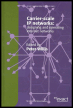
Highlights the features of large global IP networks as well as transport and access elements.
 TABLE OF CONTENTS
 S Hills, D McGlaughlin and N Hanafi
Carrier-scale IP networks can offer more than just Internet access, they can be used to deliver virtual private networks (VPNs), a service traditionally offered by frame relay and ATM networks. A VPN uses a shared infrastructure to carry traffic for multiple domains (e.g. different customers or communities of interest). Privacy (i.e. traffic separation) is provided using various techniques that can reside at layer 2 or layer 3 of the OSI model. IP VPNs, in particular, apply segregation at layer 3.
The key factor in VPNs is that all traffic from one domain (or customer) shares the same infrastructure as other domains, leading to economies of scale. This is achieved while maintaining security and separation from other domains (or customers). The main driver to the development of IP VPNs is therefore cost.
This chapter concentrates on the latest IP VPN technologies tag switching (MPLS, see Chapter 15) and IP security (IPSec) compares them to legacy systems, and positions them against each other.
Tag switching was developed to advance the work of the Multiprotocol Label Switching (MPLS) Working Group in the IETF. Cisco's tag switching [1] uses MPLS [2] as its basis but provides pre-standard features, such as provider-based tag VPNs. BT's and Concert's tag switched network is built to offer a managed IP VPN service using Cisco routers. Subsequently the term 'tag' is used in preference to MPLS throughout...