Carrier-Scale IP Networks: Designing and Operating Internet Networks
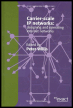
Highlights the features of large global IP networks as well as transport and access elements.
 TABLE OF CONTENTS
 S Challinor
This chapter is an easy-to-read introduction to the technology and history of IP networks. It provides a condensed summary of IP terms and concepts essential to the understanding of the rest of this book. Those with a basic understanding of IP may be tempted to skip this chapter but some may find that it covers gaps in their knowledge.
The chapter introduces the reader to IP networking, covering the fundamental principles of packet switching, through to the devices, protocols, technologies and applications used to create an IP network.
IP, the Internet protocol, stems from work started in the US Department of Defense in the late 1960s to create a network resilient enough to withstand an enemy attack.
This network, which initially linked centres of defence and academic institutions, eventually became the Internet. Figure 2.1 illustrates the dramatic growth of the Internet, and some of the milestones along the way.
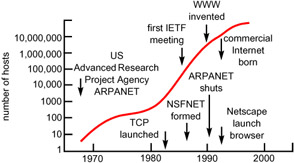
Some milestones are listed below.
1969 US Department of Defense Advanced Research Projects Agency network connecting four universities in the United States: Stanford Research Institute, UCLA, UC Santa Barbara, and the University of Utah. The network is used for applications such as e-mail and file transfer.
1973 First international connections to Arpanet University College, London, and the Royal Radar Establishment in Norway.
1979 First appearance of 'Usenet', an on-line discussion group via e-mail.
1982 TCP/IP created, the...