Control Systems Design: A New Framework

Paul Geoffrey Lane
Abstract. This chapter provides a method for computing the peak output of a scalar proper rational transfer function, when the possible input set is defined by separate 2-norm bounds on the inputs and their rates of change. The notion of an approximately worst input is considered. A wind-gust/wind-turbine environment/system couple is used to illustrate the use of the method to test matching conditions.
This chapter provides a solution to the problem of evaluating the peak output
| (2.1) | |
of a scalar proper rational transfer function f ? v( f) in the case that the possible set
is defined by
| (2.2) | ![]() |
where M, D are given positive constants. This set contains transient inputs (see Zakian, 1989).
The output v( f) is given by a convolution integral of the form
| (2.3) | ![]() |
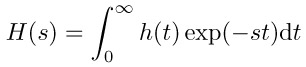
where v( f, t) denotes the value of the output v( f) at time t and h denotes the impulse response. The impulse response satisfies h( t) = 0 for t < 0 and has a proper, rational Laplace transform
| (2.4) | ![]() |
whose poles have negative real parts. This ensures finiteness of the peak output. Because the system is rational, state-space methods can be used to evaluate certain integrals that are...