Data Quality: The Accuracy Dimension

An informative resource for any data management staff, IT management staff, and CIOs of companies with data assets.
 TABLE OF CONTENTS
 Analysis of column properties is the process of looking at individual, atomic values and determining whether they are valid or invalid. To do this, you need a definition of what is valid. This is in the metadata. It consists of a set of definitional rules to which the values need to conform.
In the industry, these types of rules are generally not referred to as rules. They are commonly referred to as domain definitions, column specifications, column descriptions, or column properties. However, they can all be considered rules because they provide a definition of what can be put into a column. For example, a column specification that the length of a column is 10 characters is basically a rule that says the maximum length is 10. All of the specifications for the content of an individual column are rules that restrict the values that can be considered valid. They are generally not expressed in a rule language or rule syntax.
To understand this chapter you need to know how certain terms are defined and subsequently used. These terms are column, domain, properties, null, and field overloading. These terms are notorious for having different meanings, depending on the author or product using them. Defining how they are used in this text will reduce the risk of confusion. Figure 8.1 shows how these terms relate to one another.
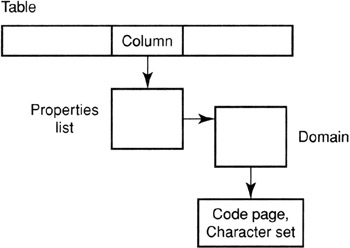
The most basic element of a database is an individual column. In some systems this is called...