Developing .NET Web Services with XML
Write higher-level applications in less time using this hands-on guide, and learn the interrelated Web Services involved with .NET and XML.
 TABLE OF CONTENTS
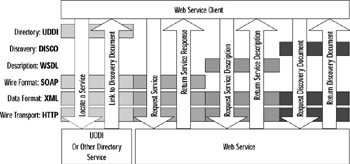
 Web Services are useful only if clients can find out what services are available in the first place, where to locate them, and how exactly those services can be called. A number of initiatives are under way driven by the major vendors in the Web Service area to address those application development and business needs. Two of the more important ones, both of which are supported by the Microsoft .NET Framework and fully integrated into Visual Studio.NET , are the following:
Web Service Description Language (WSDL) An XML format to describe how a particular Web Service can be called, what arguments it takes, and so on.
Universal Description, Discovery, and Integration (UDDI) A directory to publish business entities and the Web Services they offer, and where you can find those services. UDDI is implemented as a Web Service itself.
Additionally, there s DISCO, a mechanism based on XML developed by Microsoft to dynamically discover Web Services running on a particular machine. Putting everything together, a picture of the world of Web Services starts to evolve that may look like Figure 5.1.
| Warning | A variety of groups with Microsoft have implemented the SOAP standard. Apart from the .NET Web Services group, these include, among others, .NET Remoting, Windows XP Message Queue, SOAP Toolkit (Web Services based on COM), and BizTalk Server. |