Handbook of Image and Video Processing

Chapter 10.4: Computer-Aided Detection and Diagnosis in Mammography

Mehul P. Sampat Mia K. Markey Alan C. Bovik,
The University of Texas at Austin

1 Introduction

The American Cancer Society estimates that 215,990 women will be diagnosed with breast cancer in the United States in 2004 [1]. Another 40,110 women will die of the disease. In the United States, breast cancer is the most common form of cancer among women and is the second leading cause of cancer deaths after lung cancer [1]. Women in the United States have about a 1 in 8 lifetime risk of developing invasive breast cancer [2, 3]. Early detection of breast cancer increases the survival rate and increases the treatment options.

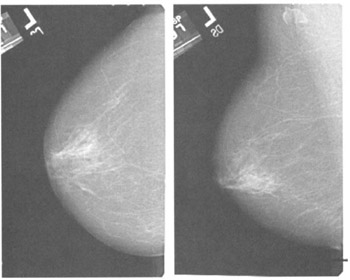
Screening mammography, radiographic imaging of the breast, is currently the most effective tool for early detection of breast cancer. Screening mammographic examinations are performed on asymptomatic woman to detect early, clinically unsuspected breast cancer. Two views of each breast are recorded; the craniocaudal (CC) view, which is a top-to-bottom view, and a mediolateral oblique (MLO) view, which is a side view taken at an angle. Examples of the MLO and CC views are shown in Fig. 1.


Figure 1: In screening mammography two views of each breast are recorded; the craniocaudal (CO view (left), which is a top-to-bottom view, and a medinlateral oblique (MLO) view I right), which is a side view taken at an angle. The images were obtained from the Digital Database for Screening Mammography (DDSM) [126]

Radiologists visually search mammograms for specific abnormalities. Some of the important signs of...

UNLIMITED FREE
ACCESS
TO THE WORLD'S BEST IDEAS

SUBMIT
Already a GlobalSpec user? Log in.

This is embarrasing...

An error occurred while processing the form. Please try again in a few minutes.

Customize Your GlobalSpec Experience

Category: Hand Drills
Finish!
Privacy Policy

This is embarrasing...

An error occurred while processing the form. Please try again in a few minutes.