Petroleum Production Engineering: A Computer-Assisted Approach

Production decline analysis is a traditional means of identifying well production problems and predicting well performance and life based on real production data. It uses empirical decline models that have little fundamental justifications. These models include the following:
Exponential decline (constant fractional decline)
Harmonic decline
Hyperbolic decline
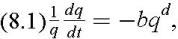
Although the hyperbolic decline model is more general, the other two models are degenerations of the hyperbolic decline model. These three models are related through the following relative decline rate equation (Arps, 1945):
where b and d are empirical constants to be determined based on production data. When d = 0, Eq. (8.1) degenerates to an exponential decline model, and when d = 1, Eq. (8.1) yields a harmonic decline model. When 0< d <1, Eq. (8.1) derives a hyperbolic decline model. The decline models are applicable to both oil and gas wells.
The relative decline rate and production rate decline equations for the exponential decline model can be derived from volumetric reservoir model. Cumulative production expression is obtained by integrating the production rate decline equation.
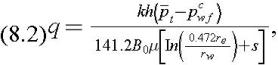
Consider an oil well drilled in a volumetric oil reservoir. Suppose the well's production rate starts to decline when a critical (lowest permissible) bottom-hole pressure is reached. Under the pseudo-steady-state flow condition, the production rate at a given decline time t can be expressed as
where
= average reservoir pressure at decline time t,
p c wf = the critical...