Physical Database Design: The Database Professional's Guide to Exploiting Indexes, Views, Storage, and More

Appendix A: A Simple Performance Model for Databases

Performance is your reality. Forget everything else.

Harold Geneen

his appendix presents a simple performance cost model for evaluating physical design methods and tradeoffs among various designs. The model includes estimations for input/output (I/O) time and network delays.

A.1 I/O Time Cost Individual Block Access

A block (or page) has been traditionally the basic unit of I/O from disk to fast memory (RAM). It can range in size from 2 to 16 KB, although 4,096 bytes (4 KB) is the most typical size in many systems. Blocks usually include many rows in a table, but occasionally a large row can span several blocks. In recent years, prefetch buffers have been used more often in operational systems to increase I/O efficiency. Prefetch buffers are typically 64 KB (in DB2, for instance). In some systems the disk track is the I/O transfer size of choice.

Block access cost

(A.1)

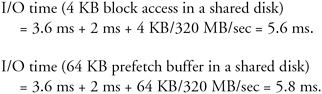
Disk access time is becoming much faster with new technologies, and currently we can estimate the access time to a 4 KB block to be well below 10 ms in a shared-disk environment. For example, an IBM U320 146 GB hard drive has an average seek time of 3.6 ms, average rotational delay of 2 ms for a half rotation (at 15,000 RPM), and a transfer rate of 320 MB/sec. For this disk, the expected block access cost in a shared-disk environment is:

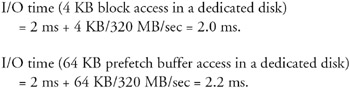
In a dedicated disk environment, the disk-seek component is rarely needed, so the time is considered negligible.

A.2 I/O Time Cost Table...

UNLIMITED FREE
ACCESS
TO THE WORLD'S BEST IDEAS

SUBMIT
Already a GlobalSpec user? Log in.

This is embarrasing...

An error occurred while processing the form. Please try again in a few minutes.

Customize Your GlobalSpec Experience

Category: PCMCIA Hard Drive Cards
Finish!
Privacy Policy

This is embarrasing...

An error occurred while processing the form. Please try again in a few minutes.