Pinch Analysis and Process Integration: A User Guide on Process Integration for the Efficient Use of Energy, Second Edition

In this section, we will present the key concepts of pinch analysis, showing how it is possible to set energy targets and achieve them with a network of heat exchangers. These concepts will then be expanded for a wide variety of practical situations in the following chapters.
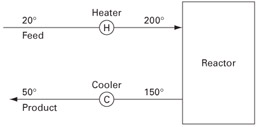
Consider the simple process shown in Figure 2.1. There is a chemical reactor, which will be treated at present as a "black-box". Liquid is supplied to the reactor and needs to be heated from near-ambient temperature to the operating temperature of the reactor. Conversely, a hot liquid product from the separation system needs to be cooled down to a lower temperature. There is also an additional unheated make-up stream to the reactor.
Any flow which requires to be heated or cooled, but does not change in composition, is defined as a stream. The feed, which starts cold and needs to be heated up, is known as a cold stream. Conversely, the hot product which must be cooled down is called a hot stream. Conversely, the reaction process is not a stream, because it involves a change in chemical composition; and the make-up flow is not a stream, because it is not heated or cooled.
To perform the heating and cooling, a steam heater could be placed on the cold stream, and a water cooler on the hot stream. The flows are as given...