Writing Windows WDM Device Drivers

A nuts-and-bolts reference highlighting the Windows Driver Model (WDM).
 TABLE OF CONTENTS
 This chapter serves as a brief introduction to the system drivers that are provided as a part of the Windows Driver Model (WDM). These bus and class drivers are a very important part of the model. You can and should use the relevant system driver to access standard types of bus. These bus drivers are sometimes called class drivers, as they let you talk to a whole class of devices.
Figure 19.1 shows the main system drivers. Chapter 2 gave a brief overview of each of these. The remaining chapters of this book look in detail at the Universal Serial Bus (USB) and Human Input Device (HID) class drivers.
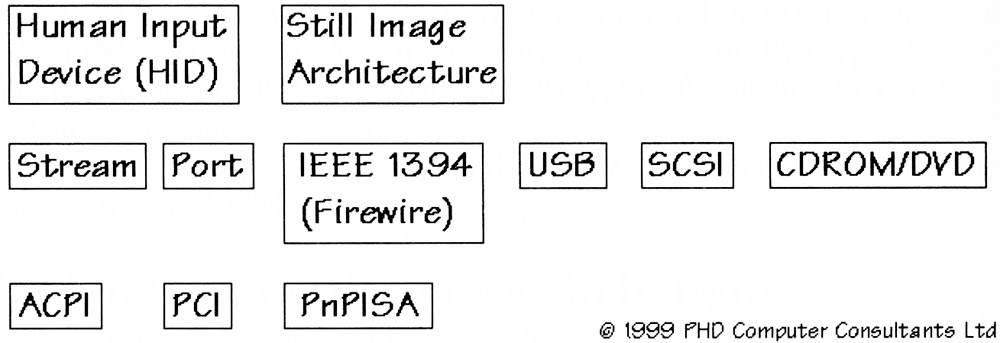
Each type of system driver has its own documentation that you must consult. In many cases, there will be a specification provided by a major standards body and a further specification provided by Microsoft for its system driver. For example, the core USB specification is produced jointly by Compaq, Intel, Microsoft, and NEC. However, the Windows USB Driver Interface (USBDI) is solely Microsoft's responsibility.
There are two main ways to work with system drivers. The first, a client, is when you use the system drivers to access your device. The second driver category interfaces the system to your hardware, by writing a minidriver, a miniclass driver, or a miniport driver. This book does not cover this last type of driver.
If you are writing a client driver, you need to understand and...