Advanced Reservoir Engineering

1.7: Injection Well Testing

1.7 Injection Well Testing

Injectivity testing is a pressure transient test during injection into a well. Injection well testing and the associated analysis are essentially simple, as long as the mobility ratio between the injected fluid and the reservoir fluid is unity. Earlougher (1977) pointed out that the unit-mobility ratio is a reasonable approximation for many reservoirs under water floods. The objectives of injection tests are similar to those of production tests, namely the determination of:

  • permeability;

  • skin;

  • average pressure;

  • reservoir heterogeneity;

  • front tracking.

Injection well testing involves the application of one or more of the following approaches:

  • injectivity test;

  • pressure falloff test;

  • step-rate injectivity test.

The above three analyses of injection well testing are briefly presented below.

1.7.1 Injectivity test analysis

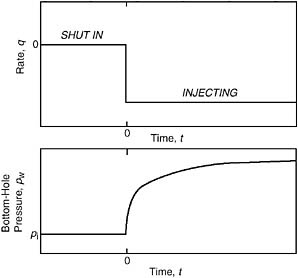
In an injectivity test, the well is shut in until the pressure is stabilized at initial reservoir pressure p i. At this time, the injection begins at a constant rate q inj, as schematically illustrated in Figure 1.119, while recording the bottom-hole pressure p wf. For a unit-mobility ratio system, the injectivity test would be identical to a pressure drawdown test except that the constant rate is negative with a value of q inj. However, in all the preceding relationships, the injection rate will be treated as a positive value, i.e., q inj > 0.


Figure 1.119: Idealized rate schedule and pressure response for injectivity testing.

For a constant injection rate, the bottom-hole pressure...

UNLIMITED FREE
ACCESS
TO THE WORLD'S BEST IDEAS

SUBMIT
Already a GlobalSpec user? Log in.

This is embarrasing...

An error occurred while processing the form. Please try again in a few minutes.

Customize Your GlobalSpec Experience

Category: Injection Pumps
Finish!
Privacy Policy

This is embarrasing...

An error occurred while processing the form. Please try again in a few minutes.