Advances in Pervasive Computing and Networking

4. The Upper Bound on the Capacity-Delay Tradeoff

4. The Upper Bound on the Capacity-Delay Tradeoff

Our first main result is to derive, from the above four tradeoffs, the upper bound on the optimal capacity-delay tradeoff of mobile wireless networks under the i.i.d. mobility model. Since the maximal achievable per-node capacity is ?(1) and this capacity can be achieved with ?( n) delay by the scheme of [3], we are only interested in the case when the mean delay is o( n).

Proposition 2.5

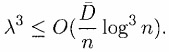
Let D be the mean delay averaged over all bits and all source-destination pairs, and let ? be the throughput of each source-destination pair. If D = O( n d),0 ? d < 1, the following upper bound holds for any causal scheduling policy,

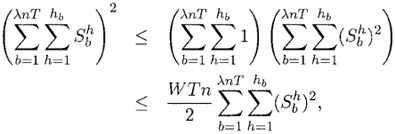
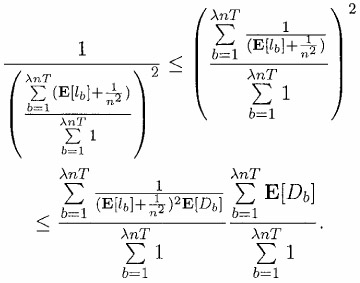
Proof: Using the Cauchy-Schwartz inequality, we have

(2.10)

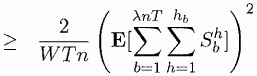
where in the last step we have used Tradeoff IV (2.9). Equality holds in (2.10) when inequality (2.9) is tight and when is equal for all b and h. We thus have,

(2.11)
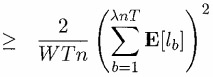
(2.12)

where in the last two steps we have used Jensen's Inequality and the Tradeoff II

(2.6), respectively. Inequality (2.11) is tight when is almost surely a constant, and (2.12) is tight when (2.6) is tight.

From Tradeoff I (2.4), we have

(2.13)

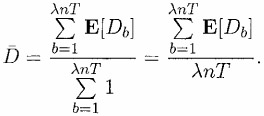
Let

Using Jensen's Inequality and Holder's Inequality, we have,

(2.14)

Equality holds when E[ l b] is the same for all b and E[ D b] =

UNLIMITED FREE
ACCESS
TO THE WORLD'S BEST IDEAS

SUBMIT
Already a GlobalSpec user? Log in.

This is embarrasing...

An error occurred while processing the form. Please try again in a few minutes.

Customize Your GlobalSpec Experience

Category: Delay Lines
Finish!
Privacy Policy

This is embarrasing...

An error occurred while processing the form. Please try again in a few minutes.