Advances in Pervasive Computing and Networking
Appendix: (2.A) Proof of Proposition 2.1

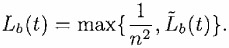
We will need the following lemma on the minimum distance from the mobile relays to the destination at any time slot. Fix a bit b that enters into the system at time slot t 0 ( b). At each time slot t ? t 0( b), recall that r b( t) is the number of mobile relays holding the bit b at the beginning of the time slot. Among these r b( t) mobile relays, there is one mobile relay whose distance to the destination of bit b is the smallest. Let denote this minimum distance, and let

It is easy to verify that

Lemma A.1

Under the i.i.d. mobility model, if n ? 3, then

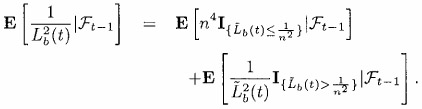
Proof: Let I A be the indicator function on the set A. By the definition of L b( t), we have,

Since the nodes move on a unit square, . Hence,

Hence,

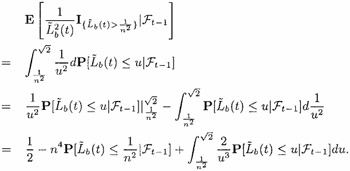
Let ? b be the distance from any one mobile node to the destination of the bit b. Then, due to the i.i.d. mobility model, we have,

and,

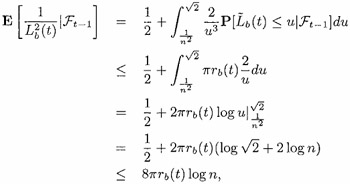
Therefore,

when n ? 3. Finally, since r b( t) is t -1-measurable, we have

Q.E.D.

Proof of Proposition 2.1 : Let

Then for all t ? t 0( b), V t is also t-measurable and . By Lemma...

UNLIMITED FREE
ACCESS
TO THE WORLD'S BEST IDEAS

SUBMIT
Already a GlobalSpec user? Log in.

This is embarrasing...

An error occurred while processing the form. Please try again in a few minutes.

Customize Your GlobalSpec Experience

Category: Driver Bits
Finish!
Privacy Policy

This is embarrasing...

An error occurred while processing the form. Please try again in a few minutes.