A Classical Introduction to Cryptography: Applications for Communications Security
7.3: Computing Orders in Groups

7.3 Computing Orders in Groups

7.3.1 Finding the Group Exponent

As explained in Section 7.1.2, we recall that the exponent of a group is the smallest nonnegative integer ? such that x ? = 1 for all x in the group (assuming that the group is multiplicatively denoted). For cyclic groups, the exponent is obviously the order of the group. For instance in Z n (which is additively denoted), the exponent is n since n is the smallest x such that x.1 ? 0 (mod n) and we have n.x ? 0 (mod n) for any x ? Z n.

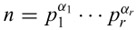
In the case of , ? is denoted ?( n) as the Carmichael function. We can easily prove that if n = is the factorization of n, then

which should be compared to

Finding the exponent of is not easy. It is actually as hard as factoring n: obviously, the factorization of n allows to compute ?( n) by the above formula. The opposite is a little more subtle. Let us assume that we can compute ? = ?( n) and let us factorize n.

Let us first take an example with n = pq with p and q different primes such that p ? q ? 3 (mod 4). This way we have

UNLIMITED FREE
ACCESS
TO THE WORLD'S BEST IDEAS

SUBMIT
Already a GlobalSpec user? Log in.

This is embarrasing...

An error occurred while processing the form. Please try again in a few minutes.

Customize Your GlobalSpec Experience

Category: Logic Counters
Finish!
Privacy Policy

This is embarrasing...

An error occurred while processing the form. Please try again in a few minutes.