A Classical Introduction to Cryptography: Applications for Communications Security

Chapter 4: Conventional Security Analysis

Overview

Content

?Attack methods: differential cryptanalysis, linear cryptanalysis

?Security analysis: nonlinearity, Markov ciphers

?Security strengthening: indistinguishability, dedicated construction, decorrelation

Previous chapters presented brute force attacks and dedicated attacks. This chapter investigates classical general attack methods for conventional cryptographic algorithms (namely, differential and linear cryptanalysis), and different ways to strengthen the security in primitive design or to estimate the resistance against attacks. For further readings we recommend the tutorial Ref. [90] of Howard Heys on differential and linear cryptanalysis.

4.1 ?Differential Cryptanalysis

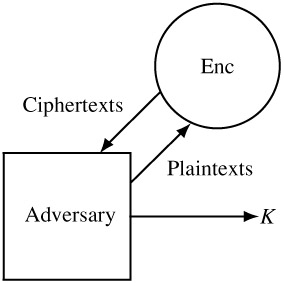
The idea of differential cryptanalysis is originally due to Eli Biham and Adi Shamir from the Weizmann Institute in Israel. [1] It assumes a chosen plaintext attack model: the adversary can play with the encryption device as a black box, submitting chosen plaintexts and getting ciphertexts in return (see Fig. 4.1). The aim of the attack is to recover the secret key.


Figure 4.1: Chosen plaintext attack.

The basic idea of differential cryptanalysis is to investigate differential behaviors: we submit pairs of random plaintext blocks the difference of which is a fixed value a. We then look at the corresponding ciphertext difference until it is a fixed value b. A first analysis phase consists of looking for good a and b values in a heuristic way. A crucial quantity is the differential probability defined by

DP f ( a, b) = Pr[ f( X + a) = f( X) +

UNLIMITED FREE
ACCESS
TO THE WORLD'S BEST IDEAS

SUBMIT
Already a GlobalSpec user? Log in.

This is embarrasing...

An error occurred while processing the form. Please try again in a few minutes.

Customize Your GlobalSpec Experience

Category: Network Security Services
Finish!
Privacy Policy

This is embarrasing...

An error occurred while processing the form. Please try again in a few minutes.