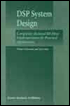
DSP System Design: Complexity Reduced IIR Filter Implementation for Practical Applications
Chapter 2: Frequency Transformations High-Order Mappings for Digital Signal Processing

1. AN OVERVIEW

The idea of the frequency transformation where each delay of an existing FIR or IIR lowpass filter transfer function is replaced by the same allpass filter is a simple one and allows a lot of flexibility in manipulating the original filter to fit the required specification. Although the resulting designs are considerably more expensive in terms of dimensionality than the original prototype, the ease of use (in fixed or variable application) is a big advantage and has ensured that such mappings are frequently used for IIR filter designs. A general idea of the frequency transformation is to take an existing filter and produce some other filter replica from it in the frequency domain.

Up to now the definitive mapping equations are those put forward by Constantinides [30] and since adopted as industry standard . These wellknown equations are geared up to map lowpass to bandpass and several other highly stylized combinations. They are culmination of preceding work [37] [39] which departures from the earliest transformation work by Broome [40], where a simple modulation approach (suffering from severe aliasing) was used. Recent work [41], [42] has strengthened the utility of both of these methods. The basic form of mapping in common use is:


Here H p (z) is a prototype filter acted upon by, in general case, an N th-order complex allpass mapping filter, H M (Z), as described by (2) thus forming a target filter, H T (z). The choice of an...

UNLIMITED FREE
ACCESS
TO THE WORLD'S BEST IDEAS

SUBMIT
Already a GlobalSpec user? Log in.

This is embarrasing...

An error occurred while processing the form. Please try again in a few minutes.

Customize Your GlobalSpec Experience

Category: IC Electronic Filters
Finish!
Privacy Policy

This is embarrasing...

An error occurred while processing the form. Please try again in a few minutes.