Fundamentals of Semiconductors: Physics and Materials Properties, Third Edition

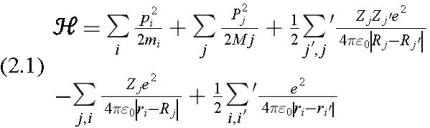
The Hamiltonian describing a perfect crystal can be written as
in the cgs system of units. (As mentioned in the preface to this edition, we have printed in red symbols which must be added to the cgs expression to convert them into Si units. ? 0 represents the permittivity of vacuum). In this expression r i denotes the position of the ith electron, R j is the position of the jth nucleus, Z j is the atomic number of the nucleus, p i and P j are the momentum operators of the electrons and nuclei, respectively, and ? e is the electronic charge. ? ? means that the summation is only over pairs of indices which are not identical.
Obviously, the many-particle Hamiltonian in (2.1) cannot be solved without a large number of simplifications. The first approximation is to separate electrons into two groups: valence electrons and core electrons. The core electrons are those in the filled orbitals, e. g. the 1 s 2, 2 s 2, and 2 p 6 electrons in the case of Si. These core electrons are mostly localized around the nuclei, so they can be "lumped" together with the nuclei to form the so-called ion cores. As a result of this approximation the indices j and j ? in (2.1) will, from now on, denote the ion cores while the electron indices i