Fundamentals of Semiconductors: Physics and Materials Properties, Third Edition

The reader will have noticed, especially in Chaps. 6 and 7, that a great deal of the information thus far presented has been obtained by spectroscopic techniques. By this is meant experiments in which the number of elementary excitations in a given infinitesimal energy interval (density of excitations) is measured. Among the excitations we have discussed are phonons, which have low energies, in the range of zero to 0.1 eV. Excitations of electrons from occupied valence to the empty conduction bands, and the corresponding excitons, have energies in the 0.1 10 eV range, an energy range which includes visible photons (1.8 3.5 eV).
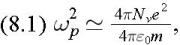
We may ask whether excitations at higher energies play any role in semiconductor physics. Indeed they do. As an example we mention the collective plasma oscillations of all the valence electrons which occur at the angular frequency (known as the plasma frequency, see Problem 6.3)
where N v is the density of valence electrons and m the free electron mass.
The plasma oscillations with frequency defined by (8.1) lead to quantized excitations, known as plasmons, with a quantum of energy
. [1] For a typical tetrahedrally coordinated semiconductor with N v = 4/atom we find from (8.1) a plasmon energy for the valence electrons in the 15 16 eV range. This range of photon energy is known as the vacuum ultraviolet (VUV) region because air absorbs UV photons with energies higher than 6 eV. Thus, optical experiments in this photon...