HCI Beyond the GUI: Design for Haptic, Speech, Olfactory and Other Nontraditional Interfaces

Chapter 3: Gesture Interfaces

Michael Nielsen Thomas B. Moeslund Moritz St rring Erik Granum

This chapter provides an introduction to the domain of gesture interfaces. We begin with the foundation of gesture interfaces and how and where they are commonly used, followed by basic theory that will help you select and design a gesture interface, and related advice and warnings. Next, we present a procedure to identify and test good gestures for a design and a practical example of how to use this procedure. Finally, we provide a short perspective on our vision of the future as the interface evolves.

3.1 GESTURES

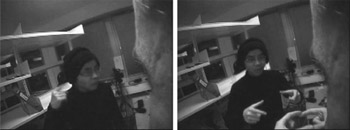
Gestures originate from natural interaction between people. They consist of movements of the body and face as nonverbal communication that complements verbal communication. This is the inspiration behind using gesture interfaces between man and machine. Figure 3.1 shows an interaction between two people that relies on nonverbal communication. The camera is mounted on the ear of one person. As seen here, interpretation is context dependent. They cannot hear each other because of loud music, and the person with the camera wants to order a drink. The gesture by the person at the left means "I cannot hear you." The person (at the right) with the camera on his head is using an iconic gesture to show what he wants. The other person imitates his gesture.


Figure 3.1: Interaction based on nonverbal communication. Gestures between two people who cannot hear each other

A gesture interface can be seen as an alternative or complement to...

UNLIMITED FREE
ACCESS
TO THE WORLD'S BEST IDEAS

SUBMIT
Already a GlobalSpec user? Log in.

This is embarrasing...

An error occurred while processing the form. Please try again in a few minutes.

Customize Your GlobalSpec Experience

Category: Head-up Displays
Finish!
Privacy Policy

This is embarrasing...

An error occurred while processing the form. Please try again in a few minutes.