An Integrated Approach to Software Engineering, Third Edition
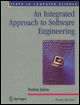
Bolstered by numerous examples, chapter summaries, and a helpful bibliography, this book provides an introduction to software engineering for undergraduate students of computer science.
 TABLE OF CONTENTS
 In the previous section we discussed black-box testing, which is concerned with the function that the tested program is supposed to perform and does not deal with the internal structure of the program responsible for actually implementing that function. Thus black-box testing is concerned with functionality rather than implementation of the program. White-box testing, on the other hand is concerned with testing the implementation of the program. The intent of this testing is not to exercise all the different input or output conditions (although that may be a by-product) but to exercise the different programming structures and data structures used in the program. White-box testing is also called structural testing, and we will use the two terms interchangeably.
To test the structure of a program, structural testing aims to achieve test cases that will force the desired coverage of different structures. Various criteria have been proposed for this. Unlike the criteria for functional testing, which are frequently imprecise, the criteria for structural testing are generally quite precise as they are based on program structures, which are formal and precise. Here we will discuss three different approaches to structural testing: control flow-based testing, data flow-based testing, and mutation testing.
Most common structure-based criteria are based on the control flow of the program. In these criteria, the control flow graph of a program is considered and coverage of various aspects of the graph are specified as criteria. Hence, before we consider the criteria, let...