An Integrated Approach to Software Engineering, Third Edition
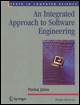
Bolstered by numerous examples, chapter summaries, and a helpful bibliography, this book provides an introduction to software engineering for undergraduate students of computer science.
 TABLE OF CONTENTS
 In previous chapters we discussed two different approaches for system design. In system design we concentrate on the modules in a system and how they interact with each other. Once a module is precisely specified, the internal logic that will implement the given specifications can be decided, and is the focus of this chapter. In this chapter we discuss methods for developing and specifying the detailed design of a module. We also discuss the metrics that can be extracted from a detailed design.
Most design techniques, like structured design, identify the major modules and the major data flow among them. The methods used to specify the system design typically focus on the external interfaces of the modules and cannot be extended to specify the internals. Process design language (PDL) is one way in which the design can be communicated precisely and completely to whatever degree of detail desired by the designer. That is, it can be used to specify the system design and to extend it to include the logic design. PDL is particularly useful when using top-down refinement techniques to design a system or module.
One way to communicate a design is to specify it in a natural language, like English. This approach often leads to misunderstanding, and such imprecise communication is not particularly useful when converting the design into code. The other extreme is to communicate it precisely in a formal language, like a programming language. Such representations...