IPv6 Core Protocols Implementation

This section illustrates how the ND protocol messages are used to perform the various functions necessary to facilitate communication among different nodes.
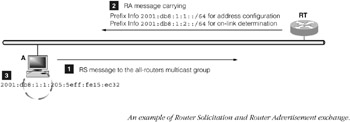
In Figure 5-2, host A generates a Router Solicitation message as part of its initial configuration process. Router RT responds with a Router Advertisement message containing two prefixes, one for address autoconfiguration and one for on-link determination. Host A configures an address 2001:db8:1:1:205:5eff:fe15:ec32 using the advertised prefix and verifies the uniqueness of this address through DAD.
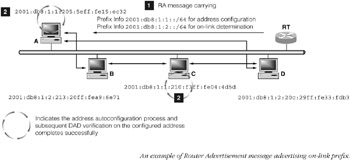
In Figure 5-3, router RT sends out Router Advertisement messages periodically. The Router Advertisement message advertises the prefix 2001:db8:1:1::/64 for address configuration. The Router Advertisement message also advertises the prefix 2001:db8:1:2::/64 as an on-link prefix. Host A and host C each generates an address using prefix 2001::db8:1:1::/64 upon receiving the Router Advertisement message. The DAD algorithm verifies the uniqueness of these generated addresses.
When host A and host C want to communicate with host B or host D, on-link determination at host A and host C will indicate that both host B and host D are in fact on-link, which means these hosts can communicate with each other directly. In this example, we assume host B and host D are configured to ignore the Router Advertisement message, and these hosts will not generate addresses based on prefix 2001:db8:1:1::/64 as a result.
In Figure 5-4, host A initiates communication to host B for the first time. Host...