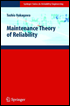
Maintenance Theory of Reliability

An operating unit is repaired or replaced when it fails. If a failed unit undergoes repair, it needs a repair time which may not be negligible. After the repair completion, a unit begins to operate again. If a failed unit cannot be repaired and spare units are not on hand, it takes a replacement time that might not be negligible. A unit forms an alternating renewal process that repeats up and down states alternately in Section 1.3.2. Some reliability quantities such as availabilities, expected number of failures, and repair limit times have already been derived in Chapter 2.
When a unit is repaired after failure, i.e., corrective maintenance is done, it may require much time and high cost. In particular, the downtime of such systems as computers, plants, and radar should be made as short as possible by decreasing the number of system failures. In this case, to maintain a unit to prevent failures, we need to do preventive maintenance (PM), but not to do it too often from the viewpoints of reliability and cost.
The optimum PM policy that maximizes the availability was first derived in [1]. Optimum PM policies for more general systems were discussed in [2], [3], [4], [5], [6]. The PM policies for series systems by modifying the opportunistic replacement [7] and for a system with spare units [8], [9] were studied. The PM model where the failure distribution is uncertain was considered in