Missile Guidance and Control Systems

6.3: Lambert's Theorem

6.3 Lambert's Theorem

With the preliminaries complete, we will now discuss Lambert's theorem. The German mathematician Johann Heinrich Lambert (1728 1777) showed in the eighteenth century (in 1761) that in elliptic motion under Newtonian law, the time required in describing any arc depends only on the major axis, the sum of the distances from the center of force to the initial and final points, and the length of the chord joining these points. Therefore, if these elements are given, the time can be determined regardless of the form of the ellipse.

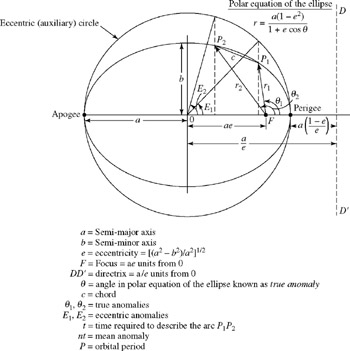
Consider now Figure 6.7. Let E 1 and E 2 be the eccentric anomalies of two points P 1 and P 2 in an elliptic orbit such that E 2 > E 1. Next, define 2 G = E 1 + E 2 and 2 g = E 2 ? E 1 > 0. Then the radii of the ellipse are given by [2], [3]


Figure 6.7: Geometry of the elliptic motion for deriving Lambert's theorem.

Adding the two radii r 1 and r 2 results in


or


since


Table 6.1: Parameters of an Elliptical Orbit

Known Elements

Symb.

Quantity

a, e

p, e

r p, e

r a, e

r a, r p

a

Semi-major axis

a

b

Semi-minor axis

p

Semi-latus rectum

a(1 ? e 2)

p

r p(1 + e)

r a(1 ? e

UNLIMITED FREE
ACCESS
TO THE WORLD'S BEST IDEAS

SUBMIT
Already a GlobalSpec user? Log in.

This is embarrasing...

An error occurred while processing the form. Please try again in a few minutes.

Customize Your GlobalSpec Experience

Category: Water Quality Photometers and Colorimeters
Finish!
Privacy Policy

This is embarrasing...

An error occurred while processing the form. Please try again in a few minutes.