Nuclear Power
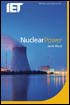
Aimed at industry professionals rather than academics, this book explains in detail how nuclear power works, its costs and benefits as part of the electricity supply system, and examines its record.
 TABLE OF CONTENTS
 The work of Albert Einstein had shown that if two nuclei fused there would be an energy release, but classical physics says that two particles with the same sign of electrical charge will repel each other, like two opposed magnets. There are clearly exceptions at the atomic scale. In nuclear fission reactors, the particle that causes the fission reaction the neutron has no charge, so it is not repelled by the nucleus and its positively charged protons. This is not the case with, for example, the alpha article, which has a double positive charge, or with some other forms of radiation.
In 1928, in parallel with the developing work on the structure of the atom and nucleus (see Chapter 1) George Gamow, a Russian-American theoretical physicist, derived a quantum-mechanical formula which allowed that in some cases two charged particles could overcome their mutual electrostatic repulsion and come very close together. This quantum-mechanical probability is now known as the Gamow factor . It is widely used to explain the measured rates of certain radioactive decays. It was necessary to know the Gamow factor to estimate how often two nuclei with the same sign of electrical charge would get close enough together to fuse and thereby generate energy.
Meanwhile, theoretical explanations were being developed for energy production in the sun and other stars and the fusion of atomic nuclei was one possibility. In the decade that followed Gamow s work, he and other physicists used the Gamow...