Aimed at industry professionals rather than academics, this book explains in detail how nuclear power works, its costs and benefits as part of the electricity supply system, and examines its record.
An element with atomic number of 89 (actinium) or above.
Activation product
A radioactive isotope of an element (e.g. in the steel of a reactor core) created by neutron bombardment.
Activity
The number of disintegrations per unit time inside a radioactive source. Expressed in becquerels.
ALARA
As Low As Reasonably Achievable, economic and social factors being taken into account. This is the optimisation principle of radiation protection.
Alpha particle
A positively charged particle from the nucleus of an atom, emitted during radioactive decay. Alpha particles are helium nuclei, with 2 protons and 2 neutrons.
Atom
A particle of matter which cannot be broken up by chemical means. Atoms have a nucleus consisting of positively charged protons and uncharged neutrons of the same mass. The positive charges on the protons are balanced by a number of negatively charged electrons in motion around the nucleus.
Background radiation
The naturally occurring ionising radiation which every person is exposed to, arising from the earth s crust (including radon) and from cosmic radiation.
Barn
see Cross section.
Base load
That part of electricity demand which is continuous, and does not vary over a 24-h period. Approximately equivalent to the minimum daily load.
Becquerel
The SI unit of intrinsic radioactivity in a material. One becquerel measures one disintegration per second and is thus the activity of a quantity of radioactive material which averages one decay per second. (In practice, GBq or TBq are the common units.)
Beta particle
A particle emitted from an atom...
Copyright The Institution of Engineering and Technology 2007 under license agreement with Books24x7
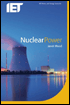
 TABLE OF CONTENTS