OpenVMS with Apache, OSU, and WASD
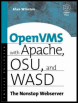
Whether you're an experienced webmaster new to OpenVMS or an old Open VMS new to webservers, this book will save you time and help you do your job better.
 TABLE OF CONTENTS
 The name "Perl" officially stands for "practical extraction and report language," reflecting the original use of the language, but in more than a decade of evolution by open source development, Perl has grown to be far more than that. Perl is a cross-platform Swiss Army knife of software, a veritable toolkit in itself, with applications in reporting, to be sure, but also in system management, database maintenance, and, most dramatically, on the Web.
Perl, not to put too fine a point on it, is the glue that holds the Web together. I'll explain more about that subsequently.
Larry Wall released the first version of Perl in December 1987. The point, to start with, was to extract data from variously formatted text files and to be able to write reports with them. Larry is a linguist, and Perl has grown as a syncretist language, like English, able to adopt idioms from other languages (some awk, some sed, some C, some sh) and become increasingly powerful and expressive, acquiring regular expressions in version 2, binary data in version 3, and considerable extensibility in version 5.
All of this has made Perl into the anti-Pascal. Where one important branch of computer science has concentrated on purity of design (and con-comitant aspects, such as the ability to automatically generate code from algorithms and the ability to formally prove that the code matches the algorithm), producing languages of severe beauty such as Pascal and Modula-2, Perl has gone the other...