Management Extra: Project Management

Gantt charts give an overview of a project. The Gantt chart is likely to be the document that summarises all the plans for the project. It provides an at-a-glance view and so is especially useful for presenting to stakeholders and your project sponsor when you're ready for the go-ahead.
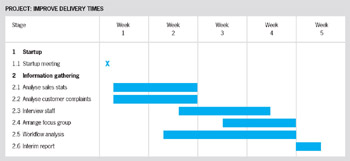
A Gantt chart, in its simplest form, consists of two elements: task and time. Tasks can be specified as individual pieces of work, or aggregated upwards into blocks of activities or whole stages. Time will normally be broken down into periods of weeks or months, depending on the length of the project. Time periods are normally numbered, as in the example in Figure 3.18, or dated, for example w/c 14 May. The length of elapsed time allocated to each activity is then blocked out on the timetable.
Though simple, Gantt charts have an immediate impact. They are a powerful way of showing the length of time that different activities are expected to take, and which activities will be running at the same time. With the aid of the Gantt chart it is worth considering the following:
Are there time overlaps in project activities that will put a strain on resources? If the project team is small and one person in it is carrying out a number of activities, you may have to revise some of the start and end dates. For example, in Figure 3.18, if the same person...