QoS in Packet Networks

It is conventional to denote a random variable by a bold letter and a deterministic variable or a fixed value by a regular letter. For example, a random variable may be denoted by x and a fixed value that x can take, by x.
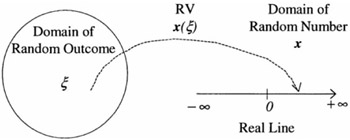
A random variable (RV) x is a function of a random outcome ? of a random experiment that maps a random outcome to a real value: x( ?). As discussed in Section 1, random outcomes could be any objects. It can be the faces of a die in die throwing, the colors of the balls in the ball drawing, etc. Random outcomes could also be real numbers, discrete or continuous. A number can just be an object of a set. A term "real line" is used to denote the set of all real numbers, i.e., the continuum, from - ? to + ?. Since the real line is a continuum, discrete points are also included in the set. Figure 2-1 illustrates the mapping from ? to x on the real line.
In the die throwing experiment, the space is a set of six possible outcomes:
| (2-27) | |
These six outcomes are not numbers; they are simply objects that constitute the set S. An RV is a function that relates these objects to real numbers.