QoS in Packet Networks

This chapter discusses the following topics:
Components of digital communications system
Network impairments and their sources
Subjective testing
Voice quality
Codec performance
Blocking probability for connection-oriented packet services
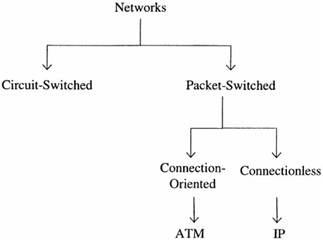
In general, telecommunications networks are divided into circuit-switched and packet-switched networks. Packet-switched networks are further divided into connection-oriented and connectionless packet networks. Figure 3-1 shows this classification.
A connection-oriented packet network service consists of the following three phases:
Connection establishment
Data transfer
Connection tear-down
In the connection establishment phase, the source and the destination perform "handshaking" to establish a logical connection between the two peer entities. If the two end systems are connected by a dedicated line, the handshaking could be a simple exchange of a "hello" and a response to initiate a communications session. On the other hand, if the two ends are connected by a packet network offered by a public network service provider, the protocol exchange for connection set-up process could be more involved. The connection establishment is based on the destination address.
Once the connection establishment phase is complete, the data transfer phase begins. Each packet contains an identifier for the virtual connection used for the data transfer. At each packet switching or forwarding node, the packets are switched (or forwarded) based on this identifier; that is, routing decisions for the packets are based on the identifier associated with the virtual connection instead of the destination address. Therefore, the individual packets of connection-oriented services do...