The RF in RFID: Passive UHF RFID in Practice

Appendix 2: Harmonic Functions

A2.1 Sines and Cosines

The archetype of a smooth periodic signal is the sinusoid (Figure A2.1), typically written as the product of the angular frequency ? and time t. The two closely related functions sine and cosine, abbreviated sin( x) and cos( x), where the arguments of the functions are here expressed as radians. The argument can also be expressed in degrees. There are 2 ? radians in a circle, so one radian = (180/ ?) ? 57 degrees.


Figure A2.1: Sines and Cosines as a Function of Time.

Both functions are periodic with a period of 2 ? radians, so if we write the sine as sin(2 ? f t), where t is time, then f = 1/period = frequency. We often use the angular frequency ? = 2 ?f, in which case the sine becomes sin(( ?t). Frequency is measured in Hertz (abbreviated Hz); 1 Hz is one full cycle of the function per second. Thus when the frequency is 900 MHz = 900000000 Hz, the angular frequency is about 5.65 billion radians per second.

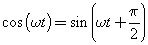
Both of these functions alternate between a maximum value of 1 and minimum value of --1; cosine starts at +1, and sine starts at 0, when the argument is zero. We can see that cosines and sines are identical except for an offset in the argument (the phase) :

(A2.1)

We say...

UNLIMITED FREE
ACCESS
TO THE WORLD'S BEST IDEAS

SUBMIT
Already a GlobalSpec user? Log in.

This is embarrasing...

An error occurred while processing the form. Please try again in a few minutes.

Customize Your GlobalSpec Experience

Category: IC Electronic Filters
Finish!
Privacy Policy

This is embarrasing...

An error occurred while processing the form. Please try again in a few minutes.