The RF in RFID: Passive UHF RFID in Practice

Appendix 4: Reflection and Matching

A4.1 Reflection Coefficients

In most of our discussion, we have assumed that radios, tags, and antennas are all well-matched, so that any power coming from one goes into the other. What happens when this is not the case? How do we measure the deviation from ideality, and what can we do about it? In this appendix we provide a very brief introduction into reflection coefficients and impedance matching.

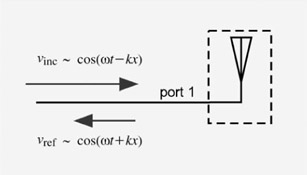
In Microwave Land, a port is a connection from one microwave environment to another for example, from a cable to an antenna. The cable, or any other signal-carrying electrical connection whose properties are well-defined and don't change along its length, is often known as a transmission line. A signal traveling along a transmission line ideally doesn't change its shape as it moves down the line, but only its phase. Transmission lines generally have a characteristic impedance, the ratio of the voltage due to a current traveling along the line to the current, that is a real resistance: 50- ?, transmission lines are very commonly encountered in microwave applications. The signal traveling along the transmission line to an antenna or other component may be partially reflected if the impedances of the antenna and the line do not match (Figure A4.1).


Figure A4.1: An Incident and Reflected Signal.

The ratio of the reflected signal to the incident signal is the reflection coefficient:

(A4.1)

The reflection coefficient is in general complex, since the phase of the incident and reflected waves may not...

UNLIMITED FREE
ACCESS
TO THE WORLD'S BEST IDEAS

SUBMIT
Already a GlobalSpec user? Log in.

This is embarrasing...

An error occurred while processing the form. Please try again in a few minutes.

Customize Your GlobalSpec Experience

Category: Vector Network Analyzers
Finish!
Privacy Policy

This is embarrasing...

An error occurred while processing the form. Please try again in a few minutes.