Scaling of Structural Strength

This book focuses on the effect of structure size on structural strength and failure behavior. The author shares his theories on size effects, and the result of quasibrittle materials.
 TABLE OF CONTENTS
 Let ? 0 = ? 0 /D denote the relative crack length for D ? ?, which is the case of LEFM. For D ? ?, the relative FPZ size in terms of a shrinks to a point, in which case ? 0 = ? 1 = ? 2. In studying the size effect, we consider structures of different sizes that are geometrically similar, and so ? 0 is constant.
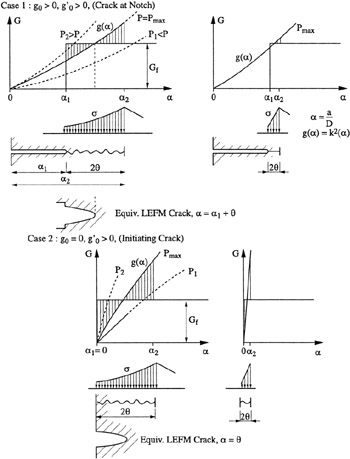
Depending on the values of k 0 = k( ? 0) and  , three different cases of scaling of the smeared-tip model with a fixed K-profile must be distinguished.
 > 0)
> 0)When there is a notch or preexisting stress-free crack (which may be produced by fatigue under previous repeated loads), k( ? 0) = 0. If the fracture geometry is negative, i.e. k'( ?) < 0, FPZ moves away from the tip in a stable manner at increasing load. For failure to occur while the FPZ is still attached to the tip of notch or preexisting stress-free crack (Fig. 9.5, Case 1), the geometry must be positive. Thus, for Case 1, we assume:
| (9.34) |  |