Scaling of Structural Strength

This book focuses on the effect of structure size on structural strength and failure behavior. The author shares his theories on size effects, and the result of quasibrittle materials.
 TABLE OF CONTENTS
 Different types of size effect are exhibited by sea ice failures. The scaling of failure of floating sea ice plates in the Arctic presents some intricate difficulties. One practical need is to understand and predict the formation of very long fractures (of the order of 1 km to 100 km) which cause the formation of open water leads or serve as precursors initiating the build-up of pressure ridges and rafting zones.
Large fractures can be produced in sea ice as a result of the thermal bending moment caused by cooling of the surface of the ice plate (Fig. 4.1). Due to buoyancy, the floating plate behaves exactly as a plate on elastic Winkler foundation, with the foundation modulus equal to the unit weight of sea water. Under the assumption that the ice plate is infinite and elastic, of constant thickness h, that the temperature profiles for various thicknesses h are similar, and that the thermal fracture is semi-infinite and propagates statically (i.e., with insignificant inertia forces), it was found (Ba ant 1992b) that the critical temperature difference

| (4.1) | 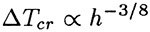 |
This means that the critical nominal thermal stress ? N ? h -3/8. The analysis was done according to LEFM. Despite the existence of a large fracture process zone, LEFM is justified because a steady-state propagation must develop. The fracture process zone does not change...