Ship Stability for Masters and Mates, Sixth edition – Consolidated 2006

Chapter 6: Transverse Statical Stability

Recapitulation

  1. The centre of gravity of a body G is the point through which the force of gravity is considered to act vertically downwards with a force equal to the weight of the body. KG is VCG of the ship.

  2. The centre of buoyancy B is the point through which the force of buoyancy is considered to act vertically upwards with a force equal to the weight of water displaced. It is the centre of gravity of the underwater volume. KB is VCB of the ship.

  3. To float at rest in still water, a vessel must displace her own weight of water, and the centre of gravity must be in the same vertical line as the centre of buoyancy.

  4. KM = KB + BM. Also KM = KG + GM.

Definitions

  1. Heel. A ship is said to be heeled when she is inclined by an external force. For example, when the ship is inclined by the action of the waves or wind.

  2. List. A ship is said to be listed when she is inclined by forces within the ship. For example, when the ship is inclined by shifting a weight transversely within the ship. This is a fixed angle of heel.

The Metacentre

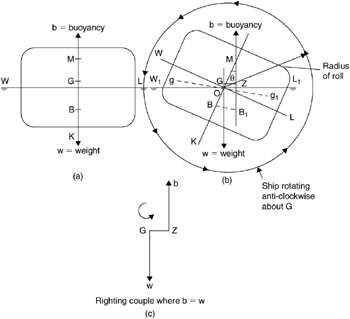
Consider a ship floating upright in still water as shown in Figure 6.1(a). The centres of gravity and buoyancy are at G and B, respectively. Figure 6.1(c) shows the righting couple. GZ is the righting lever.


Fig. 6.1: Stable equilibrium.

Now...

UNLIMITED FREE
ACCESS
TO THE WORLD'S BEST IDEAS

SUBMIT
Already a GlobalSpec user? Log in.

This is embarrasing...

An error occurred while processing the form. Please try again in a few minutes.

Customize Your GlobalSpec Experience

Category: Scales and Balances
Finish!
Privacy Policy

This is embarrasing...

An error occurred while processing the form. Please try again in a few minutes.