Supply Chain Management and Advanced Planning: Concepts, Models, Software and Case Studies, Third Edition

Christoph Kilger [1] and Boris Reuter [2]
The preceding chapters deal with planning processes within one planning domain, e. g. an enterprise (demand planning, master planning) or a factory (production planning). The term planning domain constitutes a part of the supply chain and the related planning processes that are under the control and in the responsibility of one planning organization. However, the quality of a plan and the quality of the decision-making process that is based on that plan can often be improved by considering additional information that is beyond the scope of the individual planning domain.
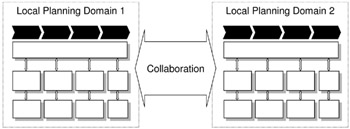
In this chapter, we describe so-called collaborative planning processes, which span multiple planning domains. The idea is to directly connect planning processes that are local to their planning domain in order to exchange the relevant data between the planning domains. The planning domains collaborate in order to create a common and mutually agreed upon plan. Thus, input data is updated faster and planning results become more accurate. Figure 14.1 shows the Supply Chain Planning Matrices of two planning domains that are connected by a collaboration.
Collaborative planning concepts can be applied to the planning processes that interface with customers (e. g. sales planning) and to those that interface with suppliers (e. g. procurement planning). Further, collaborations can be distinguished by the objects that are exchanged and collaboratively planned, such as supply capability of suppliers or material...