Supply Chain Management and Advanced Planning: Concepts, Models, Software and Case Studies, Third Edition

Herbert Meyr
University of Augsburg, Department of Production and Logistics,
Universit tsstra e 16, 86135 Augsburg, Germany
In Chap. 26 we will show how demand planning can be done when seasonality and trend are given. For a comprehensive and ostensive introduction to forecasting in general the reader is referred to Hanke et al. (2001) or Waters (1992).
This section introduces Winters' method which is appropriate for multiplicative seasonal models (see Chap. 7). In Sect. 26.2 the parameters of Winters' method are initialized. This incorporates the introduction of linear regression, too. A working example illustrates the explanations.
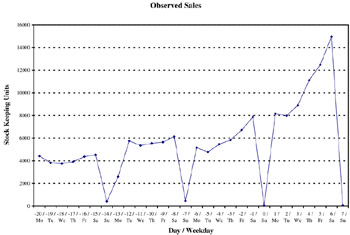
Figure 26.1 shows the sales volume of a supplementary product of a large German shoe retailer. The data are aggregated over the whole sales region and comprise a time horizon of four weeks. In our working example we use the first three weeks (days -20, , 0) as input and starting with day 1 try to estimate day by day the sales of the fourth week.
Two observations are striking when analyzing the data:
There seems to be a common sales pattern with weekly repetition. Saturdays usually show the highest, Sundays the lowest sales volume of a week. So weekly seasonality can be assumed with a cycle length...