Water Technology: An Introduction for Environmental Scientists and Engineers, Second Edition

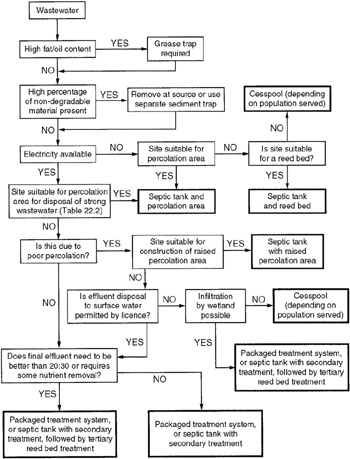
Wastewater treatment systems for individual houses are required to be cheap, robust, compact, hygienic at site, odourless, require little maintenance and be installed, and operated, by unskilled labour. Their designs are based on full-scale units but are highly modified. Selection depends on: (a) the loading to the unit (Table 22.1), (b) the treatment objectives, (c) site conditions and location within the site, (d) effluent discharge requirements, (e) unit requirements (e.g. power, maintenance, etc.) and finally (f) cost. The most commonly employed systems are cesspools, septic tanks, rotating biological contactors (RBCs), constructed wetlands and small complete treatment systems (National Water Council, 1980). Some basic guidelines to the process selection of treatment systems for small communities up to a population equivalent of 50 are given in Fig. 22.1.
| Type of accommodation | Volume of sewage (l ca ?1 day ?1 ) |
|---|---|
| Domestic house (basic) | 120 |
| Domestic house (luxury) | 200 |
| Hotel (shared bathroom) | 200 |
| Hotel (private bathroom) | 350 |
| Restaurant | 35 [a] |
| Camping site (toilets only) | 70 |
| Camping site (toilets and showers) | 110 |
| Caravan parks | 140 |
| School (day with meals) | 60 |
| School (boarding) | 200 |
| [a]Grease problem probable. |
These are underground chambers constructed solely for the reception and storage of wastewater with no treatment taking place.