Web Services: Theory and Practice

In every battle there comes a time when both sides consider themselves beaten, then he who continues the attack wins.
Ulysses S. Grant
One should not deny or try to dodge the fact that the jury, in terms of market penetration, is still out when it comes to Web services even as we approach 2004. That is a sad and unexpected fact. This is not to say that Web services have not happened. Web services are available and are being used, albeit in the case of corporate deployments, primarily on an intranet/ extranet basis. But there are also publicly available Web services. These adhere to the original vision of the serve yourself software smorgasbord on the Web.
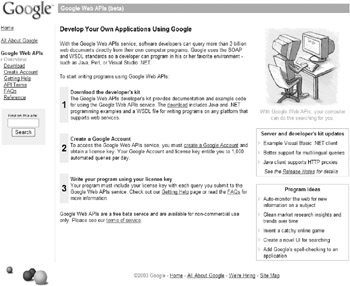
Google, for example, as shown in Figure 8.1, offers its much sought after search capability, now spanning in excess of 3 billion Web documents, as a SOAP and WSDL compliant bona fide Web service. Then there is the Microsoft MapPoint Web Service often referred to in this book as a quintessential example. In addition, as shown in Figure 8.2, amazon.com, always at the forefront of Web-centric innovation, now offers the well-known capabilities of its site (e.g., collecting information about a set of products, whether it be books, CDs, or DVDs) in the form of bona fide, SOAP-based XML Web services. These three offerings, by chance, also happen to highlight another, much anticipated feature of Web services the programmatic delivery of functionality previously available only in interactive form.