BeOS: Porting UNIX Applications
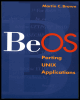
A how-to book for programmers porting applications to BeOS -- as well as those writing new apps for BeOS.
 TABLE OF CONTENTS
 For those of you who picked up this book expecting to find out what the "BeOS" in the title means, I'll explain. BeOS is the new OS from Be Inc. It runs on Intel Architecture PCs, the Apple Macintosh, and the now extinct BeBox.
The operating system itself is based on a brand-new design and some brandnew ideas in order to provide an OS for the future, rather than one stuck with the standards of the past. Dealing with this compatibility issue makes existing OSs slow and clumsy. Consider Windows 95, which still supports and in some cases uses DOS, which itself is based on CP/M. Alternatively, take a look at MacOS, previously System 7. This is still a supported OS on some of Apple's first Macs, such as the Mac Plus. The compatibility works in reverse too the new PowerPC-based Macs support 68K code. All these issues go to make up a slower OS requiring ever faster machines with more memory and more hard disk space just to support the same basic functions.
With the BeOS, the entire OS was built from scratch. To use technobabble, it's a multithreaded, preemptive multitasking OS supporting multiple processors. For the layperson, this means an OS able to do lots of things simultaneously. Better still, it's able to do lots of...