The Best Damn Cisco Internetworking Book Period
In the 1970s, Internet Protocol (IP) was developed as part of the Transmission Control Protocol (TCP)/IP effort to provide logically addressed and structured networking. Since then, IP has matured greatly, and can convey a wide array of information and services. The primary role of IP is to provide logical addresses, and to support the routing of traffic to its destination. Recent efforts to expand the capacity of IP addresses (which are nearly exhausted) have resulted in the next generation of the protocol, IP version 6 (IPv6). IP supports the ability to send to a group via multicasting. These topics are covered in this chapter, starting with IP version 4 (IPv4).
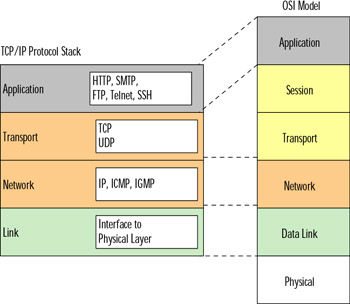
IP provides the network layer addressing and functions for the TCP/IP protocol stack, as shown in Figure 4.1. The TCP/IP protocol stack does not map neatly to the Open Systems Interconnect (OSI) model, as the OSI model was developed after TCP/IP.
IPv4 has structure and processes developed around its address space. Information is transported in IP packets, of which the header remains consistent in terms of size and fields.
IP is responsible for addressing and delivery by providing a logical address scheme. "Original" IP (referred to as IPv4) consists of 32 bits spread over four 8-bit octets, expressed in "dotted decimal" format. For example, a 32-bit address may look like this in binary:
00001010000010110000110000001101
To improve readability, the 32-bit IP address splits into four blocks of 8...