Concise Encyclopedia of Magnetic & Superconducting Materials, Second Edition
The term magnetic losses generically refers to the various energy dissipation mechanisms taking place when a magnetic material is subject to a time-varying external field H( t). As a consequence of the inherent irreversible nature of magnetization processes, part of the energy injected into the system by the external field is irrevocably transformed into heat. A case of particular interest is the one where the material is subject to a cyclic field of frequency f, with the field and the average magnetic induction B in the material remaining colinear during the process.
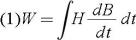
Then the time integral
over one magnetization cycle gives the energy per unit volume transformed into heat in the cycle. This integral is usually termed loss per cycle, whereas the term power loss is used to denote the loss per unit time P = fW.
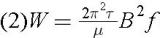
Simple expressions can be derived for W when the equilibrium relationship between field and induction in the material is linear, B = H, and the delayed response to time variations of the field is characterized by the single time constant ?. Then, the loss per cycle under sinusoidal field can be expressed as
where B represents the induction peak value in the cycle. Under these conditions: (i) hysteresis loops are elliptical that is, the system response to the sinusoidal field is sinusoidal; and (ii) the loss per cycle is proportional to the frequency.
When the system is still...