Concise Encyclopedia of Magnetic & Superconducting Materials, Second Edition
S: Single-molecule Magnets Super-resolution: Optical and Magnetic Techniques

Single-molecule Magnets

Molecular objects containing a large, but finite, number of magnetic centers whose magnetization relaxes slowly at low temperature are commonly called single-molecule magnets (SMMs) (Aromi et al. 1998). In a sense this is a misnomer, because the term magnet must rigorously apply only to systems in which the spin correlation length diverges, i.e., goes to infinity, and this is clearly not possible in a cluster with a finite size. However, the term is evocative, and it can be used, provided its true meaning is understood.

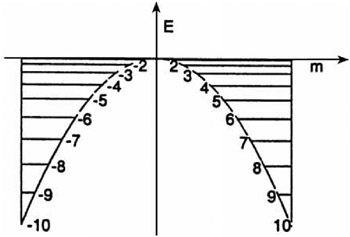
The first compound to show SMM behavior (Sessoli et al. 1993) was [Mn 12O 12(CH 3COO) 16(H 2O) 4]. 4H 2O (Mn12Ac), which has a ground S = 10 state and a large Ising-type anisotropy. The barrier for the reorientation of the magnetization is ~65K, as shown in Fig. 1. The discrete levels in the potential wells are a clear indication of the quantum nature of the system. Classically the reorientation of the magnetization can occur by overcoming the barrier, and indeed below 15K the relaxation time of the magnetization becomes very long: at 1.5K it is 40 years. Therefore, Mn12Ac behaves like a bulk magnet and shows magnetic hysteresis as shown in Fig. 2. At zero field the magnetization may be either positive or negative, depending on the history of the sample.


Figure 1: Energy levels and anisotropy barrier of the ground S = 10 state of Mn12Ac. The levels are labeled...

UNLIMITED FREE
ACCESS
TO THE WORLD'S BEST IDEAS

SUBMIT
Already a GlobalSpec user? Log in.

This is embarrasing...

An error occurred while processing the form. Please try again in a few minutes.

Customize Your GlobalSpec Experience

Category: Industrial Magnets
Finish!
Privacy Policy

This is embarrasing...

An error occurred while processing the form. Please try again in a few minutes.