Cryptography for Developers

Now that we have a basic grasp of ASN.1 syntax, we can examine the data types and their encodings that make ASN.1 so useful. ASN.1 specifies many data types for a wide range of applications most of which have no bearing whatsoever on cryptography and are omitted from our discussions. Readers are encouraged to read the X.680 and X.690 series of specifications if they want to master all that ASN.1 has to offer.
Any ASN.1 encoding begins with two common bytes (or octets, groupings of eight bits) that are universally applied regardless of the type. The first byte is the type indicator, which also includes some modification bits we shall briefly touch upon. The second byte is the length header. Lengths are a bit complex at first to decode, but in practice are fairly easy to implement.
The data types we shall be examining consist of the following types.
Boolean
OCTET String
BIT String
IA5String
PrintableString
INTEGER
OBJECT Identifier (OID)
UTCTIME
NULL
SEQUENCE, SEQUENCE OF
SET
SET OF
This is enough of the types from the ASN.1 specifications to implement PKCS #1 and ANSI X9.62 standards, yet not too much to overwhelm the developer.
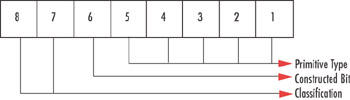
The header byte is always placed at the start of any ASN.1 encoding and is divides into three parts: the classification, the constructed bit, and the primitive type. The header byte is broken as shown in Figure 2.2.
In the ASN.1 world, they label the...