Demand Management Best Practices: Process, Principles and Collaboration
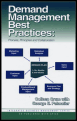
Give your organization a competitive edge by utilizing the effective demand management model process tied to an integrated business process outlined in this informative text.
 TABLE OF CONTENTS
 Demand collaboration makes such good sense. If demand information can be communicated throughout the entire supply chain, each trading partner would know how much product to have available and when. Less inventory would be needed as a hedge against uncertainty. Lead times could be shortened as less unneeded product would be made, freeing up production capacity. Sales would increase because the right amount of product would be available at the right points of consumption. As a result, all trading partners in the supply chain would reduce the cost of goods sold and increase their profits.
That is the potential, which has been validated by the relatively few companies that have successfully implemented demand collaboration processes. So why are more companies not doing it? And of the companies that have attempted demand collaboration, why are many of them disappointed by the results?
Here are the most common reasons why demand collaboration has not realized its potential:
The pace of adopting new ways of doing business is slow.
Demand information supplied by customers is not put to use in trading partners' own demand, supply, logistics, and corporate planning in an integrated manner.
Demand management and supply management processes are not integrated, and sales and operations planning is not utilized to synchronize demand and supply.
Lack of trust among trading partners to share pertinent information and collaborate on decision making.
The desire to partner but not commit to executing the...