The Economics of Recreation, Leisure and Tourism


Chapters 12 14 examined the contribution of recreation, leisure and tourism to countries national economies. Traditionally, economic analysis has measured impacts in terms of readily measurable variables such as employment, balance of payments and gross national product (GNP).
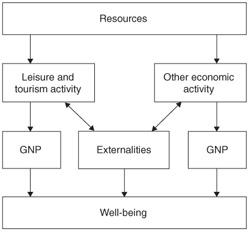
In contrast, the objective of this chapter is to examine the issues raised by environmental economics. Environmental economics involves a wider view of the impact of economic development and growth, taking into account well-being rather than just measuring how much richer people become in monetary terms. Here, issues such as global warming, acid rain and resource depletion have been highlighted as threats to economic growth and even to the future of our species, and critiques and techniques developed by environmental economists can be readily used in the recreation, leisure and tourism sector.
First, questions can be raised about the validity of focusing measures of success solely on the uncritical use of GNP data. Second, environmental accounting techniques seek to include a wide rage of considerations when considering the cost and benefits of particular projects. These include effects on the natural and built environment, as well as raw material and waste product issues. When subjected to environmental scrutiny, the recreation, leisure and tourism sector can display examples of previously unaccounted overall benefits as well as costs. Additionally, as well as being the perpetrator of negative environmental effects, the sector is sometimes the victim of environmental pollution caused elsewhere.
After studying this chapter students will be able to:
distinguish...